Dig deeper
This is the place to find evidence, data, planning tools and reports that support Cambridge Connections - check out the links below.
Project information
+ December 3 2025: Elected Members approved problem statements
At the Strategic Planning and Policy Committee, on Wednesday, December 3 2025, Elected members approved the following problem statements:
1. High growth and impacts on transport network.
Rapid population and economic growth and development in and around Cambridge, coupled with high reliance on private vehicles and limited transport choices, is placing increasing pressure on the town’s transport network and wider network connections. This is increasing congestion, delays and safety risks, increasing emissions and negatively impacting on accessibility for the community.
2. Through and across town traffic and heavy vehicles accessing through residential areas and the town centre.
Reliance on a small number of key connections, including only one bridge able to carry heavy traffic over the Waikato River in Cambridge, means all heavy and through traffic travelling east–west or north–south must pass through residential areas and the town centre. This increases crash risk for road users, increasing congestion, and diminishing the town’s amenity and character.
3. Limitations and resilience of river crossings.
The ageing and limited capacity of bridge infrastructure, exacerbated by the lack of schools and essential services on the Leamington side of town is constraining reliable and resilient transport links between Cambridge and Leamington and the wider network. These limitations reduce network resilience, disrupt connectivity during emergencies and temporary closures, and compromise the safety and efficiency of the transport system.
+ Draft strategic case and key findings from public feedback
At the meeting, Elected Members also received the draft strategic case as part of the agenda:
Strategic Planning and Policy Committee Public Agenda - 3 December 2025
This agenda includes:
- Draft problem statements - to be approved by Elected Members
- Draft strategic case - to be received by Elected Members
- Cambridge Connections Key Themes from Public Engagement Stage 1: Visioning and Transport Challenges
- Overview of Cambridge Connections Stage 1: Statistics - 12 November 2025
+ November 14 2025: Elected Member Workshop
View the slides presented at the workshop, including:
- Cambridge Connections purpose
- Key Stages
- Decision-making framework
- Community engagement
- Indicative steps to a new bridge
- Case study: Peacocke Bridge in Hamilton
- Draft Strategic Case
- Draft problem statements
In stage two, the project team will be developing a long list of transport ideas informed by the community feedback, and will be developing criteria for assessing the ideas into a short list of options.
Early Assessment Sifting Tool (EAST): The project team will use this tool to create a ‘long list’ of transport ideas, aligned with NZTA requirements. The early assessment sifting tool (EAST) supports an initial ‘coarse screening’ of alternatives and options. NZTA recommends using the EAST where there are a large number of alternatives and options to consider. It also provides a consistent format for assessing all transport-related alternatives and options and helps document decisions made.
Multi-Criteria Assessment (MCA): The project team will be developing the criteria to move from a long list to a short list of transport options. The Multi-Assessment Criteria is a structured approach used in transport planning by NZTA and others to ensure that investments are made efficiently and effectively. It emphasises the importance of making the most of existing networks and infrastructure and implementing low-cost solutions before resorting to more expensive physical infrastructure projects. This approach helps in managing growth and capacity pressures on transport networks while promoting sustainable transport options. The MCA will be approved by Elected Members.
A simple guide to Cambridge Connections
A user guide to Cambridge Connections, its purpose and how you can get involved.
Cambridge Connections Project Implementation Plan
An indepth look at the Cambridge Connections plan to December 2026.
Engagement Project Plan - August 2025
In 2025, Cambridge Connections was reset to put engagement with the community at the heart of the project. This plan outlines how Council will inform, consult and involve community voices.
NZ Transport Agency Waka Kotahi tools utilised in the development of the Cambridge Connections transport plan:
Early Assessment Sifting Tool (EAST):
Supports an initial ‘coarse screening’ of alternatives and options (see Stage Two for more information).
Multi-Criteria Assessment (MCA):
A structured approach used in transport planning by NZTA and others to ensure that investments are made efficiently and effectively. (See Stage Two for more information).
Business case for defining problems and benefits - 12 October 2025
In order to seek funding for transport, the New Zealand Transport Agency (NZTA) Waka Kotahi requires us to define the greatest problems we face and the solutions that will most benefit to our community.
Programme business case phase
Guidance on the NZTA programme business case approach that the Cambridge Connections Transport Plan aligns to.
The intervention hierarchy
Guidance on applying the intervention hierarchy as an assessment tool for optimising existing and proposed new transport investments. It considers integrated planning, demand management and best use of the existing system before new infrastructure.
One Network Framework
Guidance on classifying road and street networks to show primary use or purpose for each road in a network.
Engagement with Cambridge mana whenua
Ngaati Koroki Kahukura and Ngaati Hauaa High Level Engagement
This report was prepared in 2023 during the previous Cambridge Connections phase.
Mana Whenua involvement in the Cambridge Connections is integral to a working partnership that recognises diverse issues and circumstances that need to be considered to evolve the transport system so that it is fit for purpose and population now and into the future.
Ngaati Koroki Kahukura, and Ngaati Hauaa are Mana Whenua in Cambridge. Their cultural values directly relate to whakapapa, their ancestral lands, waters and taonga in their rohe.
The purpose of this engagement document is to provide high level input to the business case to ensure any real or perceived issues, impacts and interests of mana whenua are articulated, acknowledged and understood by Waipā District Council.
Additional matters identified by mana whenua as part of Cambridge Connections reset - 2025
In addition to the report above, mana whenua identified the following key issues, as part of the project reset:
- Social and partnership opportunities relating to infrastructure, eg. the upcoming vote on Māori wards, the creation of the waters CCO, acknowledging the centrality of the Kingitanga and Tumuakitanga, RMA partnership to uphold the principles of Te Tiriti, recognising Treaty settlements and tikanga, Te Ture Whaimana.
- Futureproofing the growth of Cambridge and surrounds so appropriate infrastructure can support that growth.
- Making sure the plan addresses multi-modal transport, bus stops, humps and bumps on roads as safety platforms for walkers, and access throughout Cambridge.
- Cultural design, noting the wording in the report should perhaps refer to mana whenua design principles, and its importance in reinforcing identify and whakapapa.
- Wayfinding, as connection to place.
- Climate resilience and adaptation, including energy and telecoms that are normally built along roads.
- Recognising that transport is one of the biggest polluters of our waterways, so a holistic approach is important.
- Cultural monitoring along the river, including stormwater, erosion and rubbish in the awa.
- Marae connection.
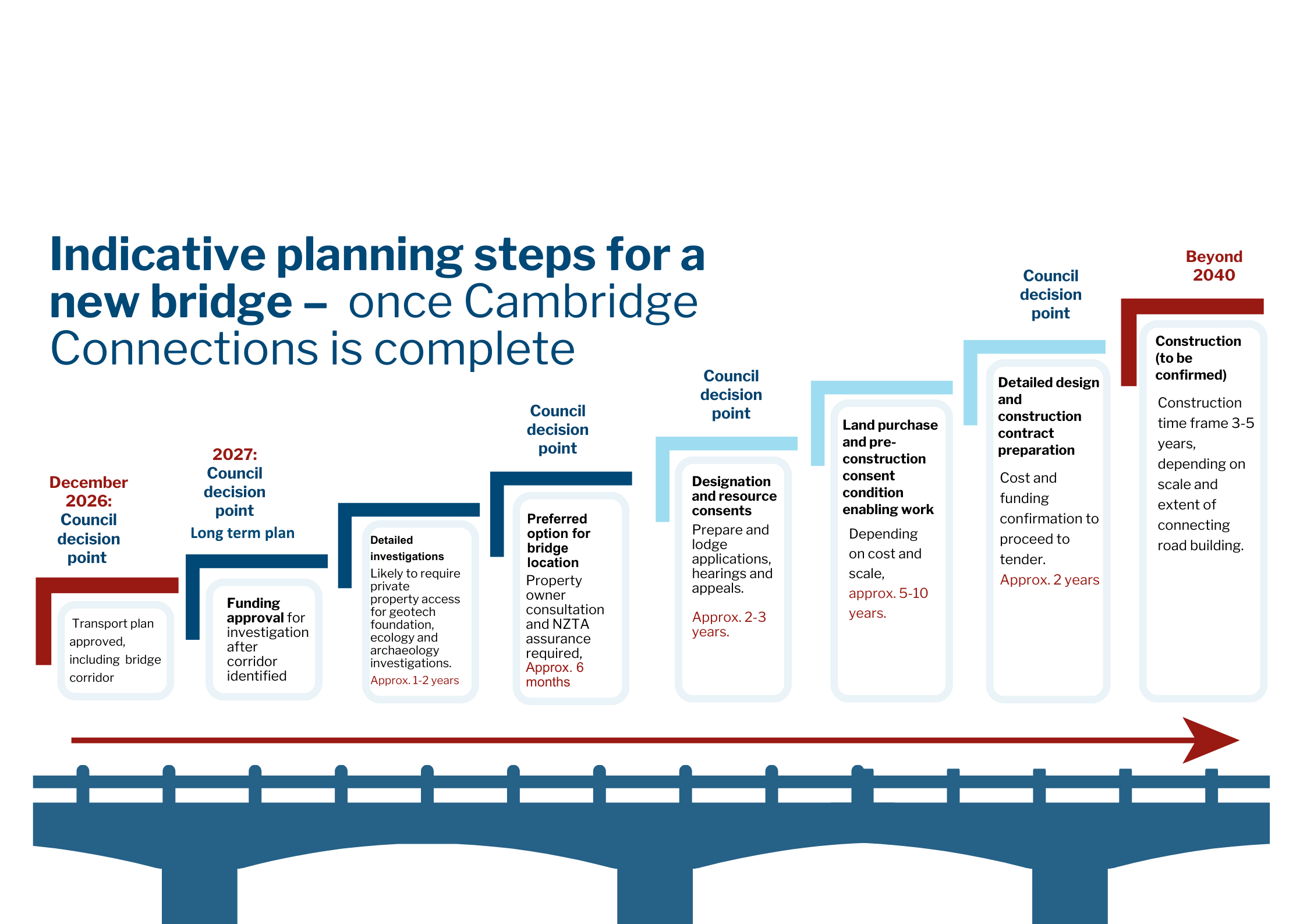
Steps to a bridge
What needs to happen to in order to plan for a new bridge, once Cambridge Connections is complete in December 2026.
Supporting information
Waipā Transport Strategy (2022-2052):
The strategy sets out the direction for the district’s transport system over the next 30 years.
Ahu Ake - Waipā Community Spatial Plan:
30 year plan for how the district should grow and develop.
Growth Strategy Waipa 2050:
The Growth Strategy is used to guide the location of future residential and business development in the district. An update of the Growth Strategy is due to be completed in 2026. This will inform the Cambridge Connections Transport Plan.
Hamilton-Waikato Metropolitan Spatial Plan
The MSP is the spatial vision and framework for how the Hamilton-Waikato sub-region will grow and develop over the next 100 + years.
Waikato Region Public Transport Plan 2022-2032
The plan is the main mechanism for the delivery of public transport services in the Waikato Region.
Arataki Regional Direction Waikato
Plan guiding land transport outcomes in the Waikato region over the next 30 years.
Future Proof Strategy: Planning for Growth (2024)
30-year growth management partnership for the Hamilton-Waikato sub-region, focused on enabling well-planned urban development, integrated transport, and climate resilience. Waipā District Council is a partner council in Future Proof.
Te Ture Whaimana o Te Awa o Waikato Vision
Strategy for restoring and protecting the health and wellbeing of the Waikato River and activities that affect it,
Waikato Regional Land Transport Plan (RLTP) (2024 – 2054):
The RLTP articulates how the Waikato Region aligns with the GPS and sets the long-term strategic direction for the next 30 years. Link:
Arataki – our 30 year plan
30 year strategic plan for New Zealand’s land transport system.
Government Policy Statement on Land Transport (2024-34)
Sets out the Government’s strategic direction for the land transport system over the next 10 years.
Build or maintain? New Zealand’s infrastructure asset value, investment and depreciation, 1990-2022
Research paper for the financial values, investment levels and depreciation trends of New Zealand’s infrastructure assets.
National Policy Statement-Urban Development (NPS-UD) 2020
Sets out the objectives and policies for planning for well-functioning urban environments and responsive to current and future needs.
What could transport look like in the future and what could that mean for Cambridge?
This document prepared by NZ Transport Agency shows how technology may shape the future of transport in Cambridge.
Everyday Guide to the Land Designation Process
This useful guide sets out the process for designating land under the Resources Management Act – including how you can make a submission if you are affected by the proposed designation. It also explains what happens once a designation is in place.
Guide to landowners: What to expect when your land is acquired under the Public Works Act 1981
This is a useful guide for those interested in the process of land acquisition. However, it’s important to note that the Cambridge Connections Transport Plan will not designate an area of land for acquisition, it will simply identify a general area where a bridge and surrounding roads could be constructed. After that, it will be a lengthy legislative process, which means any land acquisition is likely to be several years after funding becomes available.
Evidence & insights
NZ Transport Agency Waka Kotahi tools utilised in the development of the Cambridge Connections transport plan:
Business case for defining problems and benefits - 12 October 2025
In order to seek funding for transport, the New Zealand Transport Agency (NZTA) Waka Kotahi requires us to define the greatest problems we face and the solutions that will most benefit to our community.
Programme business case phase
Guidance on the NZTA programme business case approach that the Cambridge Connections Transport Plan aligns to.
The intervention hierarchy
Guidance on applying the intervention hierarchy as an assessment tool for optimising existing and proposed new transport investments. It considers integrated planning, demand management and best use of the existing system before new infrastructure.
One Network Framework
Guidance on classifying road and street networks to show primary use or purpose for each road in a network.
Draft Strategic Case for Cambridge Connections
This strategic case is in draft, and supporting evidence will continue to be developed throughout 2026.
At the Strategic Policy and Planning Committee, on Wednesday, December 3 2025, Elected Members received the draft strategic. This presents extensive background evidence to support investment in Cambridge’s transport plan over the next 30 years. The strategic case expands on:
Key problems: with evidence including peak congestion data and travel times, One Network Framework showing limited routes in town, crash data, and Victoria Bridge traffic counts.
Benefits: including opportunities for increasing travel choices and a matrix of key ‘benefits, KPIs and measures’.
This presentation examines the growth and transport context, future transport, land use and growth, how people are traveling
Cambridge Road Bridges Capacity and Demand Study
(January 2018), prepared by Beca Limited for Waipā District Council.
The study investigated historic and predicted traffic volumes across the existing bridges in Cambridge. The report showed that, based on WRTM volume outputs, demand for vehicle crossings over the Waikato River will not exceed the capacity of the existing bridges until around 2041, though some uncertainties (such as the Victoria Street Bridge’s lifespan and uncertainty in traffic forecasts) would warrant further investigations.
Victoria Bridge (Cambridge) - Resilience Review Report, (August 2018)
Prepared by Beca Limited for Waipā District Council.
The study investigated the structural and geotechnical resilience of Victoria Bridge. The report concluded Victoria Bridge was generally in good to fair condition based on the inspection information.
Victoria Street Bridge (Cambridge) Condition Assessment Report
(August 2020), prepared by Beca Limited for Waipā District Council.
The study investigated the condition and potential vulnerabilities of the Victoria Street Bridge as part of an assessment of the future life expectancy of the structure.
Victoria St Bridge - Main Arch Bridge Structural Assessment Report
(November 2021), prepared by Beca Limited for Waipā District Council
The study completed a structural assessment of the main arch span and central pin connection as a result of the recommendations from the 10 August 2020 Condition Report prepared by Beca.
Victoria Bridge Geotechnical Assessment
(August 2020) prepared by Beca Limited for Waipā District Council
The study investigated the condition and potential geotechnical vulnerabilities of Victoria Bridge in Cambridge as part of an assessment of the future life expectancy of the bridge.
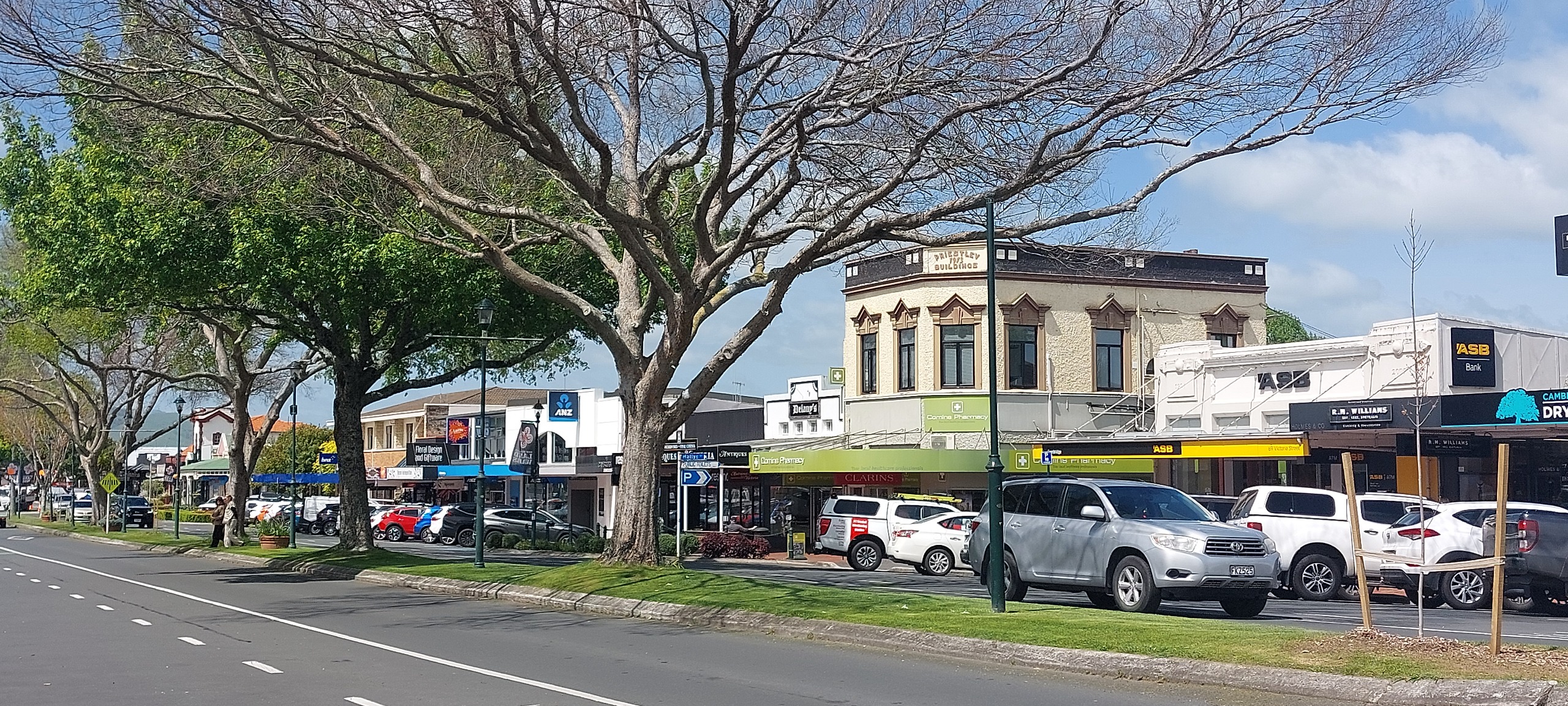
The community said they want to maintain the town character as Cambridge grows